Monday, January 9, 2017

January Week 2: HOT POTATO (Hot/Cold)

Phoneme: /c/

Transition Song: Colors by The Learning Station (See previous week for music.  I've added Pink=try to wink, and Gray - say Hooray!)

Materials: Laminated letter C, grocery bag with 4 large baking potatoes (raw, washed).

Vocabulary and Concepts: 1-2-3-4, potato, Who questions, I do/I don't, "Hot" with emphasis to articulate final /t/, cow, cookie, Carrie, carrot, computer.

Pre-literacy: talking about the letter C.  We observed how it almost looks like a circle.  We practiced drawing the letter C "Put your finger at the top.  Draw half a circle and then we stop."  Top and Stop are words that rhyme.  The Letter C does not look like a letter C when we hold it with the open end up or down. The letter C can have 2 different sounds: /k,s/.  What words have that /k/ or /s/ sound in them? Carrie, carrot, cow, computer.

Group activity: I pulled out 4 baking potatoes from a grocery bag.


Some of the children guessed that they were tomatoes.  We practiced saying potato.  Then we counted them.  We talked about how we like to eat potatoes: baked potatoes (with sour cream and butter), mashed (with or without gravy), with cheese on top.  Then I taught the children a game called Hot Potato.  First we learned the chant to say:

"Hot potato, hot potato, hot, hot, HOT!"

I explained that we would be passing them to the next person, but not throwing them.  We were pretending that the potatoes were HOT even though they really weren't.  We started passing the potatoes around (all 4 of them were at different points in our circle) while we chanted
"Hot potato, hot potato, hot, hot, HOT!" three times.  At the end I called out "Now, STOP!"  We looked to see where the potatoes ended up.

"Who has a potato?"
"I do!" (Everyone who did held them up high)
"Who does not have a potato?"
"I don't." (Everyone who did not have a potato held their hands up high)

We started up again.  We did this again and again.  The children were very excited when they had a potato to hold up when we stopped.  Everyone ended up with a potato at one point.  After a while, we switched from passing to our left to passing to our right.

At the end of the activity, many of the children asked if we could play this game again soon.


Tuesday, January 3, 2017

January Week 1: Hiding Phil (UNDER a lot of things!)

Phoneme: /c/

Transition Song: Colors by The Learning Station


Materials: Laminated letter C, Book: Hiding Phil by Eric Barclay, items to hide under (blanket, table, chair, coats)


Vocabulary and concepts: elephant, hat, house, blanket, swimming pool, bath, tree, happy, sad, nose, slide, teeter-totter, under, What questions, Who questions, Where questions.


Pre-literacy: Talk about the letter C.  Trace with "Put your finger at the top. Draw half a circle.  Now we stop."  The letter C can make 2 different sounds.  A /k/ sound or a /s/ sound.  What words do you know that have a letter C.  Miss Carrie's name starts with a letter C using a /k/ sound.  Who else has a C in their name? Other C words we discovered include cookie, cupcake, candles, candy, circus, cow, cup. The letter C almost looks like a circle. We looked at the letter backwards, forwards, and upside down.

This week we are reading a fun book by Eric Barclay titled Hiding Phil.  I used the book for my READ picture in the front hall by the office.  (The READ board features each teacher in the school with a book they recommend.  We're supposed to dress or bring props themed with the book.  Hence, the reason why I am hiding under the blanket. The kids who take the bus pass the picture to and from the classroom.  They like to point at it and remind me "Hey, that is you!)


Hiding Phil is great fun because of the funny places the children try to hide the elephant.  We also noticed the dog in the book was silly, too.  We looked at the emotions on Phil's face and the children's face. We wondered what would happen on the next page. We asked Where/What/Who questions.

The illustrations are charming.  The few words per page combined with the pictures for clues make it possible for kids to learn how to tell the story back to you.  After they know it, I like to ask the child to 'read' it to me.  Some of their retellings are quite funny!  It is a great way to promote language.

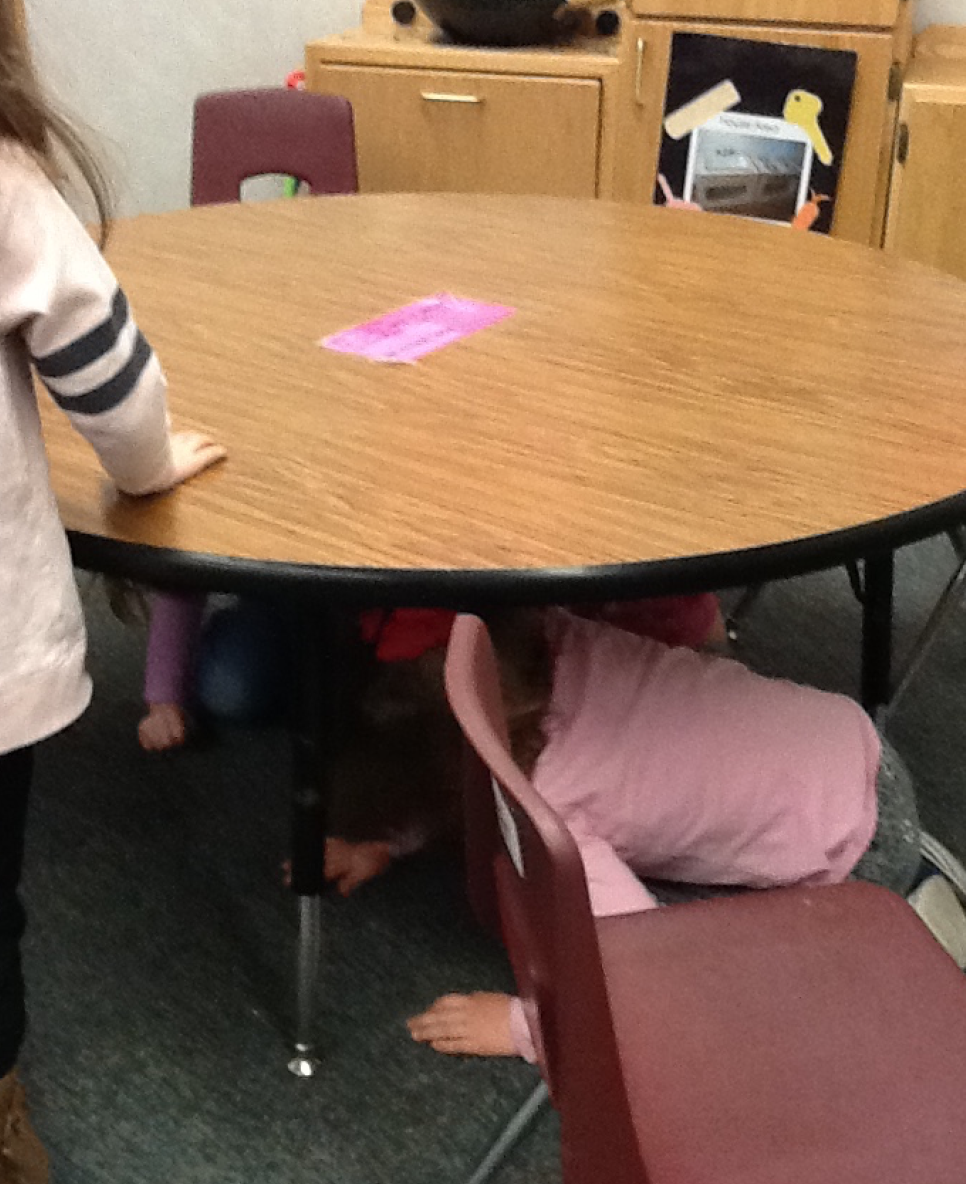
After we read the book, the children went around the room to explore what they could hide under.  They hid under the table, under chairs, under the cloths that cover the toy shelves, and under the coats on the coat rack. Their very favorite part?  I took pictures of them hiding and then we viewed them as a class at the end of Large Group.  The children had SO MUCH FUN identifying their friends or themselves on the pictures and telling us WHERE they were hiding.


Wednesday, December 21, 2016

December Week 4: School Sing-a-long

Earlier this week, all the classes had the opportunity to go caroling to the front office.  Our principal and the office ladies enjoyed our singing and clapped and thanked us.  We sang Must Be Santa (Raffi) and Jingle Bells (we also shook jingle bells during this song).  It was so much fun!

Today for large group we had a special opportunity with the morning class.  We were invited to watch the school singalong.  The school singalong is just for kids (parents weren't invited) where each grade gets to perform one song and inbetween the school sings as a group.  This morning we found out that our principal wanted us to sing the song we did when we caroled at the office earlier this week.  So the morning classes stood up in front of the entire school to sing Must Be Santa.  The kids smiled and sang and did actions.  The school cheered so loud that some of our kids put their hands over their ears.  But everyone was still smiling.  We stayed for some of the program until it was time to go to busses. Some of our kids asked "Can we do that again?"

Our afternoon classes sang songs and did actions during large group.  It was an opportunity for everyone to choose their favorite songs we had done so far this year.  Everyone's favorite is still Spooky Walk, even during the holidays.

Have a great Winter Break.  Remember we won't be back until January 3rd.

Thursday, December 15, 2016

Sensory Play: Guest Post from Miss Julie


Young children are very kinesthetic learners. They need to explore, engage, and experiment with their hands and movements. Sensory activities are often very meaningful experiences for young children. Sensory activities can incorporate many concepts. It is very easy to incorporate literacy, writing, communication, descriptive words, vocabulary, science, cause/effect, art, and mathematical skills. It is also an activity that many kids will engage with for an extended length of time. Engaging with these activities is very conducive to language development as well. Keep in mind they can get very messy! We use smocks at our sensory table and remind students often that items stay inside the table. You can make your own sensory box with a midsize container or use them outside where they can get messy.

Shaving Cream
Sand
Water
Gems
Rocks
Mud (Students were amazed I let them turn our sand into mud last year. I did use a specific sand that dries out and is easily sanitized.)
Beans
Corn
Rice
Paint
Glue
Playdoh
Tape and toilet/towel rolls
Spinning
Putty
Jumping (On trampoline or holding hands)
Squishy Balls (sensory, spikes, foam)
Sticky Items
Making Gak
Glue and shaving cream together

Our Speech-Language Pathologist suggests pudding, mashed potatoes, sticky items, and squishy fruits as a sensory and tactile activity with various students. 
(Note from Carrie:  LET YOUR CHILD GET MESSY!)


We add funnels, cups, spoons, scoops, shovels, building materials, shapes, people, animals, etc. These activities allow for a lot of dump and fill play and it’s a great visual activity too. You can hide magnet numbers, letters, shapes, various items, and search for them. Whatever items around your house or yard you are okay with your child exploring will work!


Special Books By Special Kids

Special Books By Special Kids is one of my favorite blogs and Facebook pages.

Mr. Chris is a former special education teacher.  He is passionate about advocating and teaching about people with special needs and showing how much alike we are. I love this video he posted about connecting with someone who is neurodiverse:


This is spot-on for our kids who have difficulty with communication.  If they do not communicate like you, then you find a way to adapt.  I love how Mr. Chris interviews people with many different abilities.

This is where I go when I want to watch something uplifting.  I hope you like it, too. You can also find his videos on Youtube.  If you are on Facebook, like his page to keep up with the latest videos.

Wednesday, December 14, 2016

December Week 3: Yummy Yucky

phoneme: /m/

Materials:
Laminated letter M for each child
Book: Yummy Yucky
Food/object picture for each child

Vocabulary and basic concepts:
yummy, yucky, spaghetti, worms, blueberries, crayons, soup, soap, sandwiches, sand, cookies, chocolate sauce, hot sauce, apple, pie, mud, burgers, boogers (yes, we did), eggs, earwax, fish sticks, ice cream, toilet paper, garbage, bugs, rocks, milk, broccoli, toys, scissors, fries, grapes, blocks, eggs, juice, popcorn, oranges, bananas, like/not like, middle, What questions, Who questions

Transition: Must Be Santa (by the way, we sing this MUCH SLOWER than the recording)

Pre-literacy: We're talking more about the letter M.  The children commented that it went up-down-up-down.  We noticed that the lines were long and not curved like a circle.  We talked about who had the /m/ sound in their first name.  What about their MIDDLE name?  One of the children brought it up and others asked what middle meant. Middle means between two things or in the center of something. Middle also starts with /m/ sound.  We put the letters in the middle of the rug.


We read a book titled Yummy Yucky by Leslie Patricelli.  It really is a board book for babies and very young children.  But the babies are so funny that our older kids thought it was great.  We talked about what was yummy (it has a /m/ sound in the middle!) and what was yucky.  Spaghetti? Worms?  We also talked about boogers.  Especially that we shouldn't put fingers in our noses, or we need to wash them.  We always have a few children who are surprised that putting your finger in your nose is yucky.  Hey, its preschool.

Then we passed around photos of food items, toy items, and objects like rocks.  Each of the children showed their classmates the picture they were holding, labeled the picture and then discussed if it was yummy or yucky.  We discovered that some friends didn't like certain foods we did.

Find more Leslie Patricelli books at your library.  (I use the Quiet Loud and No No Yes Yes book in class later in the year. ) Talk about foods during mealtimes.  If you don't like a food, its still important to try it every so often to see if you change your mind.  Are there things around the house or outside that we shouldn't eat?  This time of year you can also discuss things like ornaments, snow, ice melt chemicals (it looks like pretty rocks or sugar crystals), and especially those laundry soap and dishwasher soap pods.

Friday, December 9, 2016

December Week 2: Fat Cat has a problem. Let's solve it!

Phoneme:/m/

Materials:
Laminated letter M for each child
Book: What Will Fat Cat Sit On
Puppet for each child

Vocabulary and basic Concepts:
On/off, not, sitting, mad, sad, worried, happy. scared, dog, cat, cow, chicken, pig, mouse (plus animal sounds), next, behind, What questions, Where questions, emotions.

Transition:  Must Be Santa - Raffi. (first three verses only)
We are going to be caroling to the people in the front office on our last day before the holiday break.  We'll be singing Jingle Bells and Must Be Santa. We'll also be shaking jingle bells from our instrument box.


Pre-literacy:  Let's talk about the letter M!  It goes up and down like mountains. Draw up the mountain and go back down.  Go up the next mountain and down to the town.  Who has a mmmmm sound in their name?  What words have the mmmm sound in them?  Mom, monster, mad, mouse, mouth, moon, family, yummy, tummy, game, name, home.

We're reading a book titled What Will Fat Cat Sit On? by Jan Thomas.  Jan has a lot of fun books.  Go find them at your library.


Fat Cat has a problem!  (Part of Highscope is learning Conflict/Resolution.  We are constantly working with the children to learn how to solve problems together.  This book was great to emphasize conflict/resolution because everyone needs to agree on the resolution before the problem is solved.)
What will Fat Cat sit on?  The animals do NOT want Fat Cat to sit on them.  We looked at the animals' faces to guess how the animals felt about it.  Some looked worried or scared.  Dog looked MAD!  The animals had to come up with a solution to the problem.  Did Fat Cat agree to the solution?

After the book, each child picked an animal puppet to use.  We went all around the room to find places for our animals to sit on.  Some were silly (sitting on the coat rack, sitting on Miss Carrie's head), and some were logical (sitting on other chairs or the rug). We also worked on negation (Not) as in "Miss Carrie does NOT want the animals to sit on her head."

For our kids who are working to develop language, we worked on 2- and 3- word phrases (EX: Sit on.  Sit on [object].) Kids with middle language skills increased the length of the phrase (EX: My [animal] is sitting on [object].)  Our advanced peers working on negation and narration (EX: My animal] is NOT sitting on the [object]. My animal is sitting on the [object].)

At the end, everyone put their puppets on the rug and sat on a letter.  (What letter/color are you sitting on?)  Then we moved like our favorite animal to the tables to get ready for Snack Time.

(Be sure that when you read this at home, stop and talk together about the facial expressions, the animals, etc.  Let your child label the animal before you.  Ask "What does the cow say?"  Be silly while you make animal sounds together. Do more than just read the words on the page. )