Showing posts with label action words. Show all posts

Monday, March 16, 2020

March Week 2: Make A Plan

Transition Song: Wake Up Daily Routines by Dream English.


Vocabulary and Basic Concepts:  first/next/last, fast/slow, jumping, spinning, shaking, kicking, swimming, swinging, flying, push ups, sit ups, squats, ideas, plan, high/low, What questions, Who questions.

After we sang our song listed above, Miss Carrie asked:
Who got up this morning?
Who washed their face this morning?
Who brushed their teeth this morning?
Who combed their hair this morning?
Who ate breakfast this morning?
Who came to school this morning?

Everyone answered "Me!", "I did!".

Then Miss Carrie asked:
Who exercised this morning?

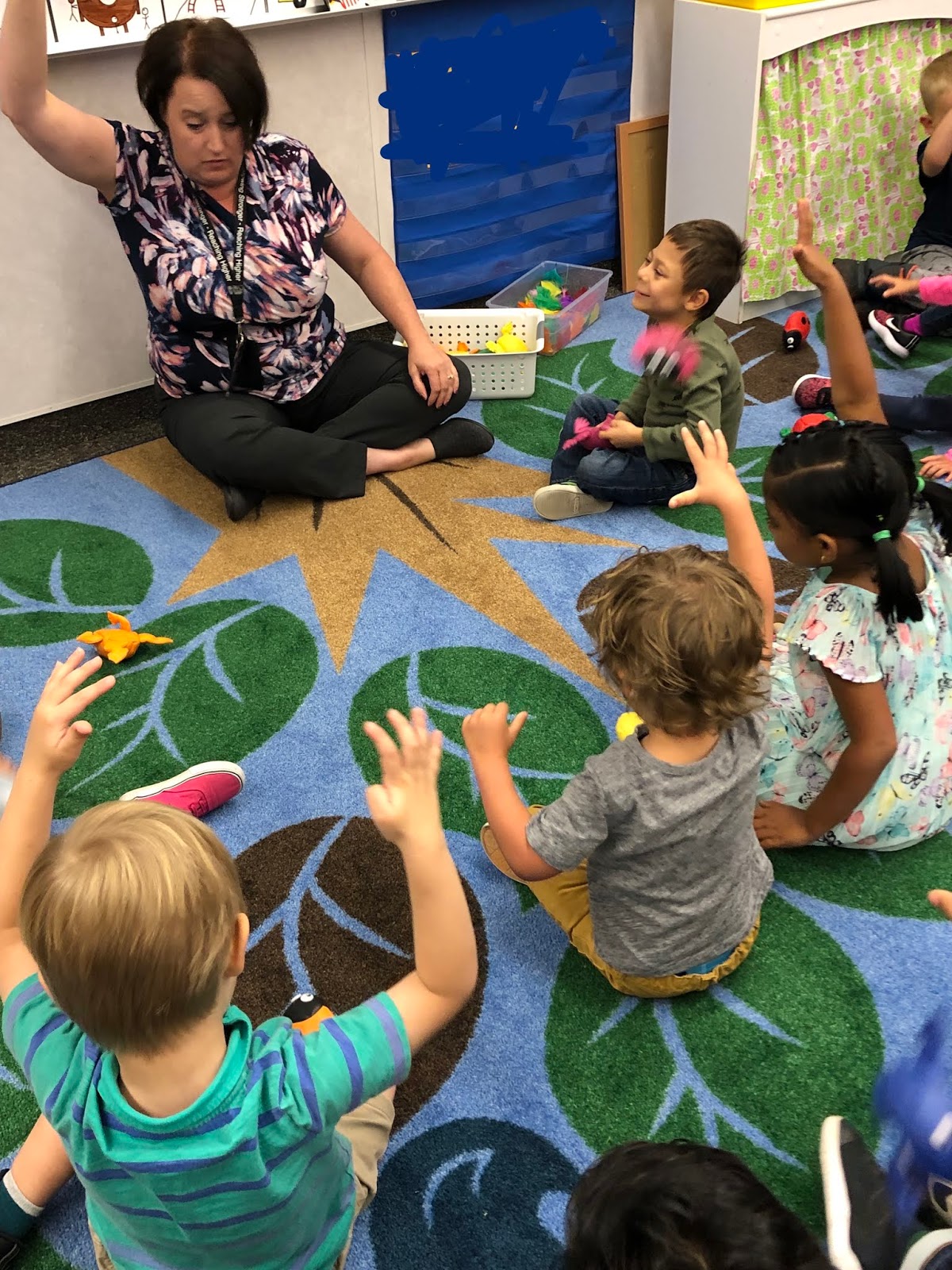
Uh-oh.  Miss Carrie forgot to exercise this morning?! We need to make a plan!  We made a plan that looked a lot like our message boards during Greeting Time.  We had to come up with an idea of what to do First, what to do Next, and What to do Last.  Miss Carrie drew the  plan on the white board.

Pssst:  Miss Carrie can't draw very well.  That is okay.  She will keep practicing. 


Can you guess what we did in this picture? 
First we did jumping jacks.  Next we flew like a bee.  Last we clapped our hands really fast.

Some classes wanted to do push ups.  A lot of push ups. Other ideas included squats, arm circles, lunging side to side, stretching side to side, stretching downward dog yoga pose, crunches, and jumping really high. We made 4, 5, and 6 plans.

DO THIS AT HOME:  make a plan and draw it down on paper.  Follow your child's lead on the plan.


Friday, February 7, 2020

February Week 1: Hiding Phil

Transition Song: H-E-A-R-T by te Kiboomers

NOTE: We sing just the first verse, clap on each letter H-E-A-R-T while we singing an repeat it a second and sometimes a third time.

Vocabulary and Basic Concepts: over/under, hide/hiding, descriptive words, locations vocabulary pertaining to the classrooms, first/next/last, Where questions, Who questions, He/She/We/They

This week we read the book Hiding Phil by Eric Barclay.  

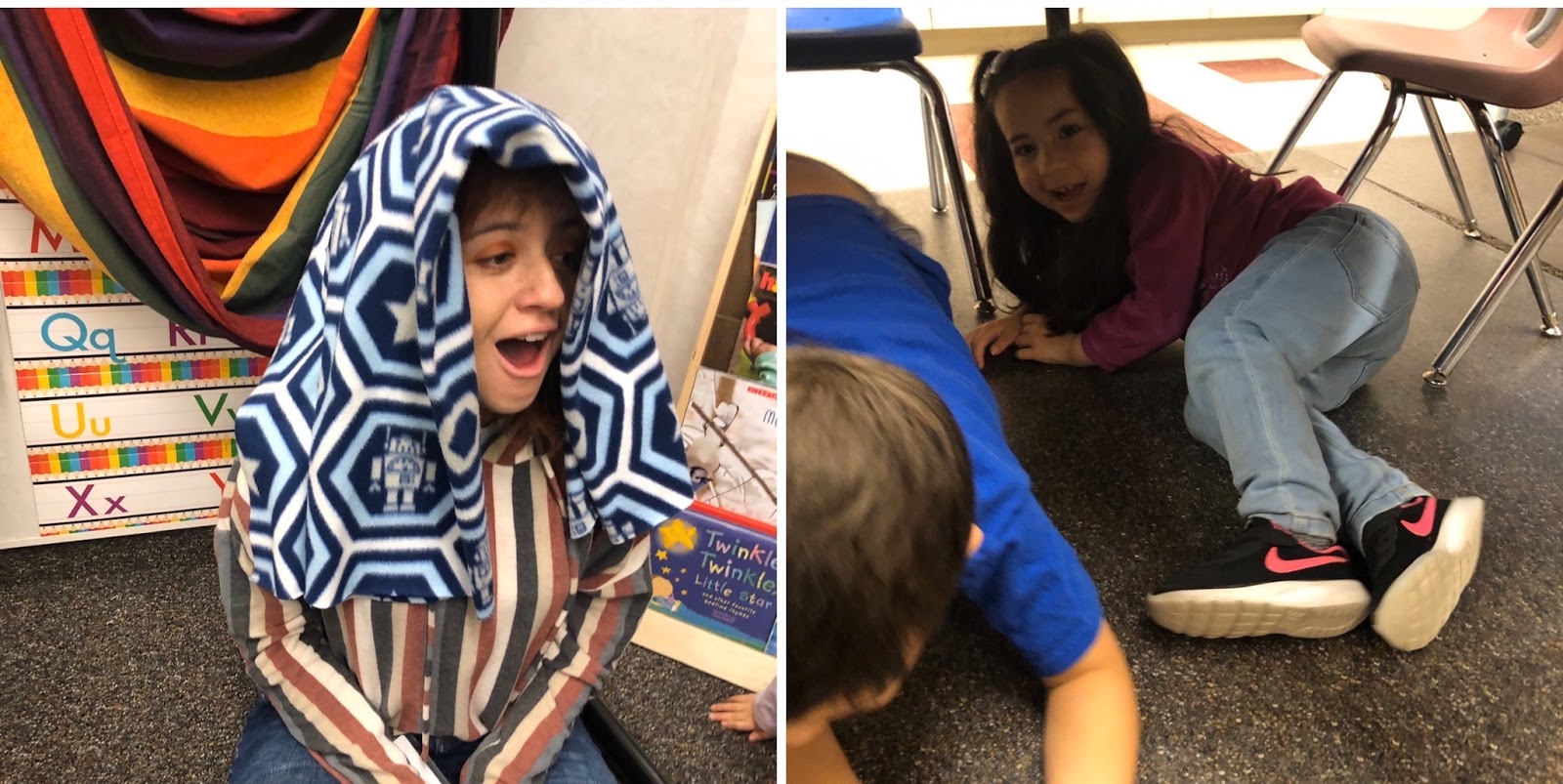
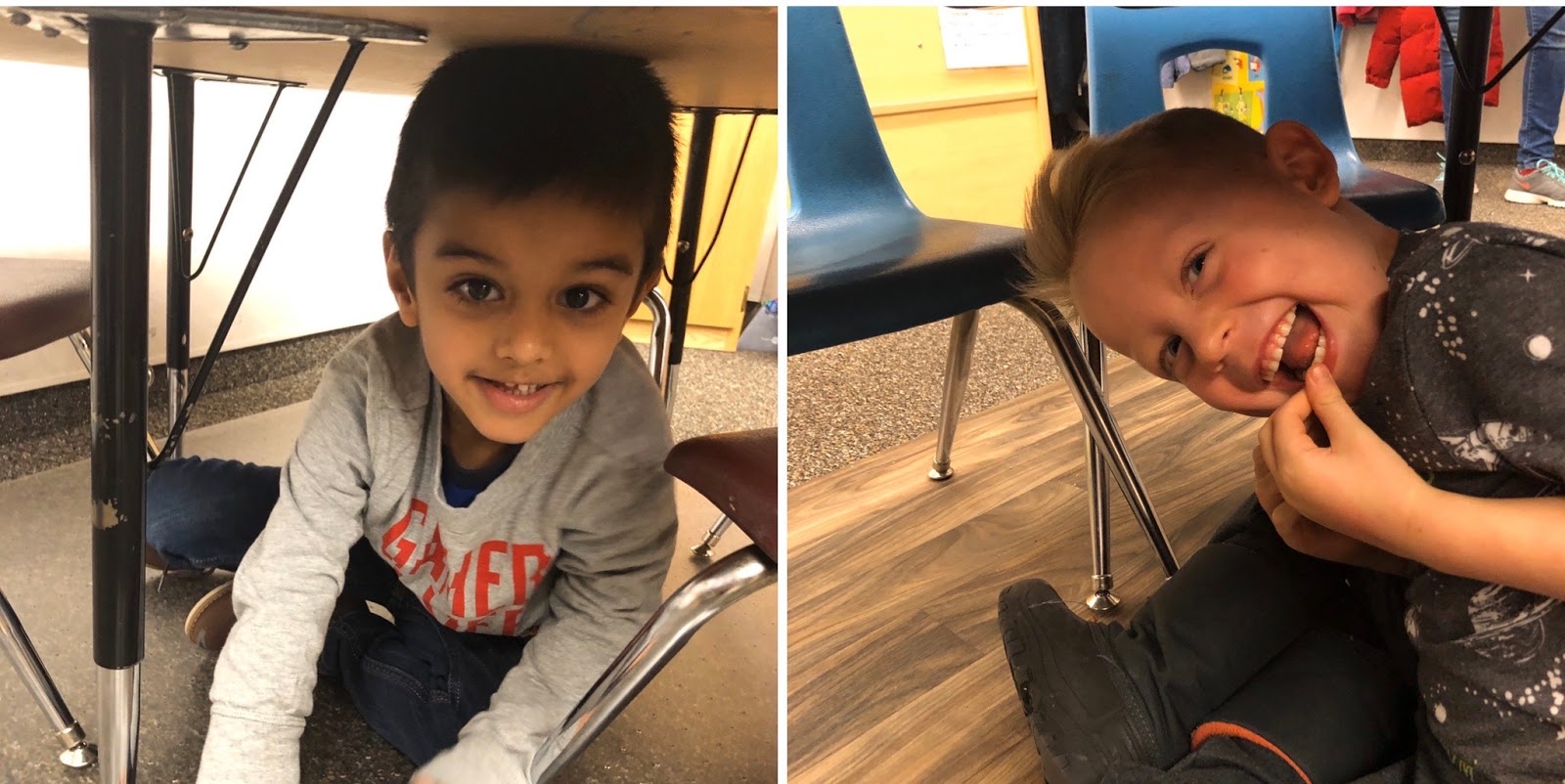
Phil is an elephant.  The kids want him to stay but they need to hide him under things.  It didn't work!  It was so much fun to see where Phil hid.  It was fun to find the dog in each picture.  Wait till you see where Phil hid last! We decided to play hide-and-seek and hid under tables, chairs, coats, blankets, and stuffed animals. Miss Carrie counted to 10 and then came to find us.  When she found us, she took our picture!  Then we looked at the pictures and talked about Who was in the picture and Where they were hiding.


DO THIS AT HOME:  play hide and seek and take pictures.  Talk about who is hiding where.  Talk about hiding under objects.  Laugh at the pictures and show them to your family.  Get everyone involved.

Friday, January 31, 2020

January Week 4: Drum Those Drums

Transition Song: Colors by The Learning Station

Vocabulary and Basic Concepts: loud/quiet, fast/slow, stop/go, big/little or small, in/out, open/closed, under/over, big/bigger/biggest, small/smaller, smallest, beat, drum, box.

This week Miss Carrie brought out boxes. So. Many. Boxes.  There were big boxes and little boxes.  we were going to drum!  But first we had to know how to stop and listen. We practiced putting our hands up whenever Miss Carrie said "Hands UP!" This meant "stop drumming and listen to directions".

Ready, set, GO! We drummed LOUD!  We discovered that when we were drumming loud, we couldn't hear Miss Jeana or Miss Jen talking.  When we drummed quietly, then we could hear them. We experimented with drumming fast and slow. We practiced go and stop (which was "hands up").

What else could we do with boxes.  We tried getting in them.  Some boxes were too little.  We could hide under them by putting them over our heads.  Some boxes were so big that we could get into them and close them. Our friends would open the boxes to find us.  We had so much fun exploring all of the boxes.


DO THIS AT HOME:  Find some boxes and make some noise.  Explore what else you can do with the boxes.  Make a fort.  Play hide and seek.  Make houses and color features on the boxes.  Let our child take the lead on what to do.

Friday, January 24, 2020

January Week 3: Do What I'm Doing

Transition Song: Colors by The Learning Station

Vocabulary and Basic Concepts: colors, body parts, look, watch, move, swing, sway, stomp reach, throw, blow, up/down, forward/backward, high/low, fast/slow, big/little, present progressive -ing, past tense-ed, Pronouns I/He/She/We + is/am/are, What questions, Who questions.

This week Miss Carrie brought her scarves.  There were lots of different colors.  If we didn't get the color we wanted, we could ask our friends to trade.  Then we danced and moved with our scarves.  Our teachers had to watch us and copy what we did.  We ha so much fun showing what we could do.  Scarves waved high and low.  We threw scarves in the air and caught them.  Then we threw them at our friends.We jumped, stepped, swayed, and swung our arms.  We sat on the floor to see what other ways we could move with just our upper bodies. Miss Carrie played fast music and slow music.


DO THIS AT HOME:  Pull out scarves or not.  But do put on some music an dance!  Follow your child's lead.  "What are you doing?  Oh, look, I see that you are stomping your feet.  I wonder if I can do that?  Stomp!Stomp!Stomp!"  "You are shaking your arms fast!  I can shake them fast, too!" Use your best sports broadcaster voice and give a play-by-play.  Have your child tell you what they are doing and let them correct you if you do it wrong.  Or, use single word narration to talk about what your child is doing to hep them label: "Stomp! Swing! Arms! Legs! Head! Shake! Fast!"

Friday, January 17, 2020

January Week 2: Dinosaur, Dinosaur

Transition Song: The Color Song by The Learning Station

Vocabulary and Basic Concepts: same/different, big/little, loud/quiet, long/short, smooth/spiny, stomp, walk, fly, run, swim, eat, identify parts of a whole (EX: The head of the dinosaur), head, back, feet, Who questions, What questions, Where questions.

This week we read a book together called Dinosaur, Dinosaur by Byron Barton.


Every time Miss Carrie said the word dinosaur we clapped it and said it with her.  The word is divided up into three parts called syllables. We practiced the word over and over.  We said dinosaur with fierce voices, with hungry voices, with tired voices, with tiny voices,  and with big voices.

Then Miss Carrie brought out toy dinosaurs. They looked just like the ones in the book!  We traded with friends if we wanted to.  Then Miss Carrie told us to look at the head of the dinosaur.  We found the head.  Miss Carrie showed us pictures and asked if our dinosaur looked like the picture.  We looked at the back of the dinosaur and the tail of the dinosaurs.  Everyone had dinosaurs that looked different. We talked about which dinosaurs walked on two feet and which ones walked on four feet.


DO THIS AT HOME:  pick out some favorite toys and compare and contrast.  What looks the same and what looks different?  Point out the parts of the toy.  Be sure to get down on the floor and play with the toys with your child.  Let your child lead on what to do.


Friday, December 13, 2019

December Week 2: Over, Under Around, and Through!

Vocabulary and Basic Concepts: over/under, up/down, around, through, walk, step, crawl, reach, stretch, squat, balance, jump, march, hop, obstacle course, What, Who, He/She.

This week Miss Carrie brought out a lot of things! There were stairs to go over, hula hoops to step over or crawl under, exercise mats to follow (Jumping Jacks! Squats! Sit And Reach! Stretch! Touch Toes! Balance! March! Hop!), and there were tunnels and tents.  Miss Carrie called it an obstacle course.

We went every where.  We tried everything. If we weren't sure what to do, we could ask a teacher. We made sure to use walking feet.  Miss Carrie took pictures of everyone.  Then we all sat down and watched the big screen.  Miss Carrie put our pictures on the big screen.  She asked "Who is that?"  "What is he/she doing?" 


DO THIS AT HOME:  what do you have around your house to make an obstacle course?  Kids think it is great fun to watch a grown up crawl under things.  If not at your house, pick a sunny day and head to the park.  Talk about what you can do.  Make  your child the leader and get ready to follow.

Thursday, September 19, 2019

August/September Week 4: Will It Bounce?

phoneme: /b/

Transition Song: Bouncy Bouncy Bouncy (the children all chose which body parts to bounce.  Most popular were head, shoulders, toes).

Materials:  feathers, bean bags in fun animal shapes, bouncy balls

Vocabulary and Basic Concepts:  bounce/bouncing/bounced,  yes/no, does/does not, high/low, roll/rolling/rolled, high/low, fast/slow, me/mine/my, He/She, Hers/His, Who/What/Where, experiment, drop, fall, float, flop, soft, squishy, my turn, negation - not

Miss Carrie introduced the word experiment.  We even clapped out the syllables ex-pe-ri-ment.  To do an experiment is to do something to see what will happen.  We can even guess what will happen.  This experiment was called Will It Bounce?.

First, Miss Carrie brought out a box of feathers.  The feathers felt soft.  We held them up high, counted 1-2-3, and dropped the feathers to see if they would bounce.  The feathers fell or floated.  They did NOT bounce. Everyone talked about what happened to their feathers.

Then we tried beanbags.  They were squishy.  We help them up and counted 1-2-3 and dropped them.  They fell and flopped.  They rolled.  They did NOT bounce.  Hmmm.  Everyone wondered what we would try next.


Miss Carrie brought out a big black bag.  What was inside the bag?  BALLS!  Everyone was certain that balls would bounce.  We held them up and counted 1-2-3 and dropped them.  Guess what happened?


The balls bounced!  Sometimes they rolled.  We bounced them to each other.  We bounced them to teachers.  We bounced the ball and tried to catch it ourselves.  Our experiment was a success.  

DO THIS AT HOME:  What bounces at your house?  Pick three objects and try the experiment.  Bubbles?  Blankets?  Shoes?  Do you have a bouncy ball?  Consider other experiments that you might try such as does this taste sweet/salty/crunchy (try different foods) or feel cold (tepid water, dryer-warmed blanket, ice cubes).  Talk about what you are doing.  Use a lot of descriptive words.


Thursday, September 5, 2019

August/September Week 2: Bouncy Big Balloon

phoneme: /b/

Transition Song: Bouncy Bouncy Bouncy

Materials: laminated letter B, small box, balloons

Vocabulary and Basic Concepts:  high/low, empty/full, descriptive words big/bigger/biggest, predicting, blow/blowing, bounce/bouncing/bounced, sitting, standing, turn-taking, hands, heads, elbows, “My turn”, pop, more

First we drew the Letter B.  "Start at the top and draw down.  Go back to the top and bounce around." What words have the /b/ sound in them?  The children came up with baby, bus, bumblebee, and bump.

Miss Carrie showed us a box.  It was a little box but it had something inside.  Something small that would get bigger


Wow!  It was a lot of balloons!  Red, yellow, green, light blue, dark blue, pink, orange, and purple.  What did Miss Carrie need to do to make the balloon get bigger?  The children suggested she blow into the balloon.


That balloon grew big and then bigger!  Miss Carrie tied the balloon and then asked "What should we do with the balloon?  Children suggested bouncing it.  Or hitting it with their hands. Or bumping it with their head.  There were a lot of balloons, enough for everyone to have one to play with.  So the teachers helped blow up more balloons.  And then this happened:


We talked about What our balloons were doing, Where they went, and Who we could ask to send them back.  Did they go high or low when we hit them? Were they heavy or light?  We talked about colors and compared sizes: "My balloon is bigger/smaller."  Sometimes we just expressed "My balloon" when we wanted it back.

DO THIS AT HOME:  have fun playing with balloons.  Get the entire family involved and talk about what you are doing, where the balloon goes, and who has it.  If it pops, talk about the loud noise and what you can do so it doesn't pop again.