Monday, February 6, 2017

February Week 2: Actions and Emotions

phoneme: /d/

Transition song: H-E-A-R-T by the Kiboomers

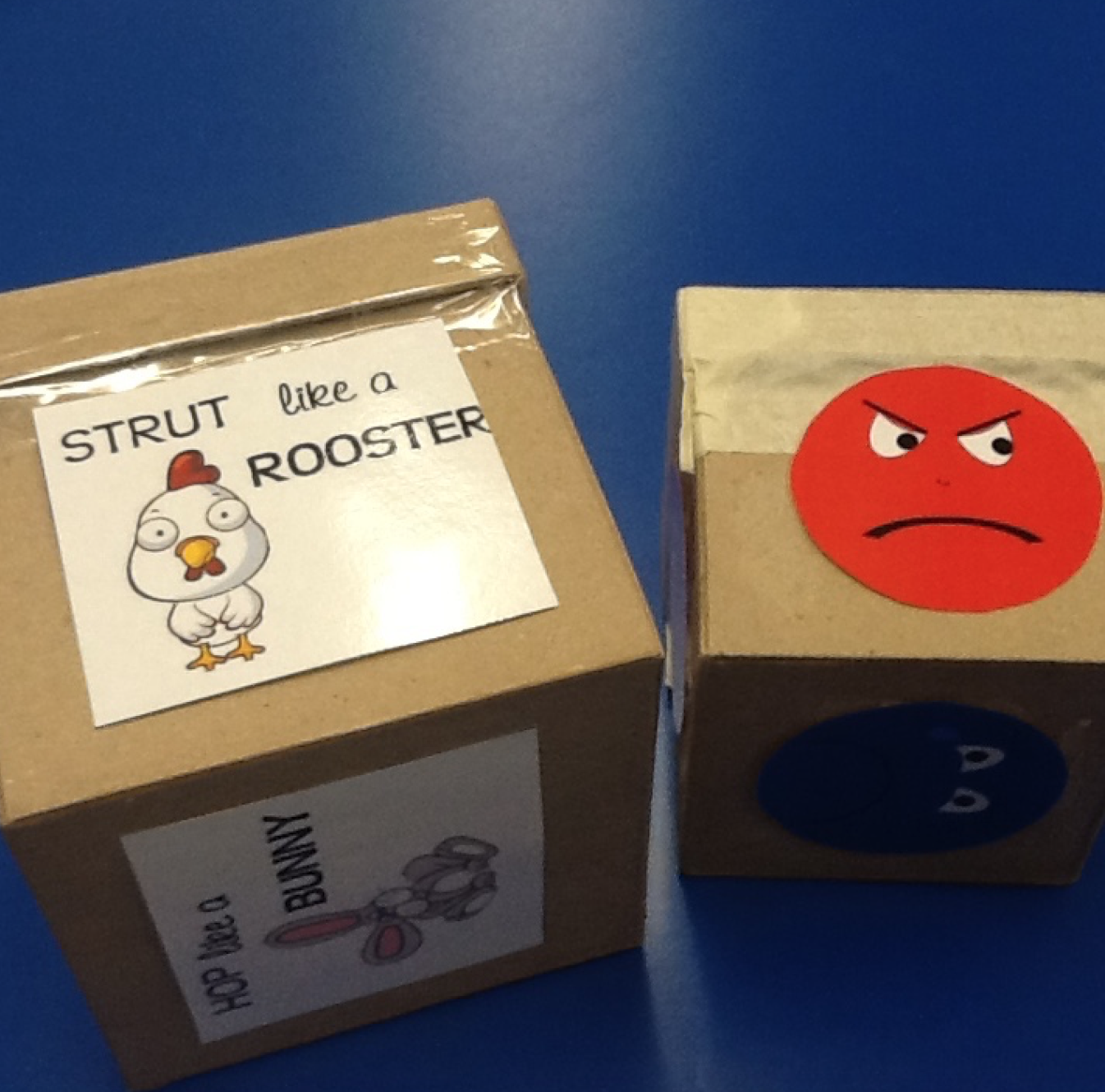
Materials: Laminated letter D, two homemade dice (one with action and one with emotions)

Vocabulary and Concepts: happy, sad, worried, mad, silly, surprised, gallop, strut, roll, stomp, hop, my turn, your turn, he is, she is, we are, following directions, descriptive words.

Preliteracy skills:  Let's explore the letter D.  I see that there is a long side and a curved side.  What words have the /d/ sound? Doctor, dad, dinner, down, mad, sad, dump.  Let's practice drawing the letter D.  Start at the top and draw down.  Go back to the top and draw around.

This week we are playing a game.  I made two dice, one with emotions and one with actions.  We took turns throwing the dice.  The pictures that are on top when the dice stop are the directions that we follow.


We might waddle like a duck with a silly face.

Or roll like a happy pig.

Hop like a worried bunny.

Gallop like a surprised horse.

Strut like a mad rooster.

This took A LOT of modeling.  But once the children understood the directions, they commented that it was a lot of fun.  I didn't get a picture of Stomp like a cow or the sad face.  There was a lot of communication between peers and adult/peers: He is funny!  She is sad.  We are waiting.

We practice emotions on our faces and looked at each other's faces....and laughed pretty hard, even if we were doing mad or sad faces.


Note that the dice are not anything more than taped empty boxes.  Square tissue boxes work well.  Many of the children asked if we could play this game again.

Thursday, February 2, 2017

February Language Calendar

Here is the February Language Calendar from Moog Center.  You can go here to their site, download it and print it out.


Tuesday, January 31, 2017

February Week 1: Draw a Map

Phoneme: /d/

Transition Song: H-E-A-R-T by The Kiboomers


(We are not eliminating a letter the way the song does.  We sing each letter and clap for each one.)

Materials: Laminated letter D, crayons, large sheet of white butcher paper (big enough to nearly cover the Large Group rug), map of the classroom.

Vocabulary and Concepts: top/bottom, long/short, big/small, house, sign, road, tree, car, trampoline, swimming pool, park, swings, rail road track, train, stop/go, library, street (add more specific to your neighborhood), Where, Who, What, tall/taller/tallest, more crayons.

Pre-literacy: Let's explore the letter D.  Look, it has a line that is straight, and a line that curves.  Draw the letter D: "Start at the top and draw down.  Go back to the top and draw around."  What sound does it make?  D-d-d-d. What words have that sound in them?  Daddy, dinner, down, draw, diaper, dog.

Large Group Activity:  Miss Jeana and Miss Julie each have a map they have drawn for their classrooms.  We looked at the map.  The children identified each area (House Area, Block Area, Puzzle Area, Art Area, Book Area) and which table was the table where they sit.  They recognize this map well because the teachers use it to ask the children where they would like to play during Work Time.  I told the children that I wanted to draw a map of the area where we lived.  I unrolled a long piece of white butcher paper on the floor with the children surrounding it.  Then I showed the children, using crayons, how I drew my house (it is a long house with a door and windows) and that my yard has very big trees and looks like a park.  Then I handed out plenty of crayons and encouraged the children to lay on their tummies and draw their house and what was around it.  See the pictures ( I will add more pictures of each class map). I have a McDonalds near my house so I drew the McDonalds sign and asked if anyone recognized it (logographic skills).  Some children drew parks, pools, trampolines, flowers, cars, a railroad track, and the street in front of their home.

Talk about WHERE things are.  WHO lives at your house?  What is TALLER than your house?  WHERE do you play?  WHERE do you eat? 

Miss Jeana's AM Class


Monday, January 23, 2017

January Week 4: More HOT and COLD

phoneme: /c/

Transition Song: Colors by The Learning Station (See January Week 1 for video.  We sing it without the music and have added pink=try to wink, and gray=say hooray).

Materials: laminated letter C, hot pad, frozen coldpacks

Vocabulary and Concepts: hot/cold, touch, feel, fingers, sink, refrigerator, microwave, snow, ice, pizza, soup, ice cream.

Pre-literacy: talking about the letter C.  We each held our letter C in different ways to see if it still looked like a letter C.  No, we can't hold it up side down or the open end pointing up.  We practiced drawing the letter C: "Put your finger at the top.  Draw half a circle and then you stop."  Top and Stop are words that rhyme - they sound the same.  We remembered that the letter C can have 2 sounds: /k,s/.  Words that have the letter C: Carrie, cold, cute (why, thank you!), cupcake, circle.

Group Activity:  Today, I brought in one hot pad and 3 frozen coldpacks.  I had the hot pad plugged in and warmed up before the children came to Large Group at the rug.  I had the children come close and touch and/or feel the hot pad.  They liked that is was so warm.  Then I passed around the cold packs.  They said it made their fingers cold.  I had them touch their cold fingers to their faces. We talked about other things that were hot and cold: summer, winter, ice, snow, wind, fire.  Then we walked around the room to look for things that might be hot or cold.  The sink has hot and cold water.  The refrigerator that holds our Snack Time drinks keeps them cold.  The microwave makes things hot.  The pizza in the kitchen could be hot (if it were real).  Miss Carrie likes to eat cold pizza.  Some of the children said they liked cold pizza, too.

We gathered back at the rug again and felt the hot pad and coldpacks again.  We talked about building snowmen and how they melt when it is warm and no longer cold.  We sang Once There Was A Snowman and grew tall-tall-tall and then small-small-small.

Look around your house and talk about what is hot and cold.  This would be a great time to talk about what is too hot to touch (stove) and other safety issues.  Also discuss that we wear coats, hats, and gloves to protect us from getting cold.  Bath time is a good time to talk about hot/cold/warm water.
Point out hot and cold foods that your family likes to eat.


Thursday, January 19, 2017

Preschool play: We're learning!

You might think this is play time, but in High Scope language, this is WORK TIME.  Children learn through play.  I wanted to show you some of the learning going on in both classrooms.
This is darling.  I asked this boy if he saw his mom or dad iron clothes.  He replied that he saw his grandpa ironing.  Note the laundry basket full of items waiting to be folded. He taught me how to fold the washcloths. Vocabulary words here could include hot/cold, flat/wrinkled, top/bottom, over/under.

This little boy LOVES to fix motorcycles.  He knew how to use that screwdriver. Vocabulary expansion here could include fix it, machine parts (Wheel, body, handle), colors, requesting help, turn on/off.

Teachers get right in there and play, too.  Here, Miss Suzanne is playing ponies.  This little boy insisted that the ice cream truck needed to bring ice cream to the ponies. Vocabulary here could include requesting, "I want _____" statements, cold, frozen, more/less.

This little girl was either selling toys or costume items. Vocabulary: more/less, "Give me______", requesting, counting.

I thought that the gorilla lived in this house.  But the boy informed me that the gorilla was INVADING the house.  Nice vocabulary word, buddy! More vocabulary: animal labeling, room labeling, on top, next to, under, in front, behind, emotions.

This little boy was working on building a colossal marble track. Vocabulary could include on top, under, front, back, next to, colors, tall/short, more, fast/slow.


This boy was building some serious architecture.  He had a specific plan and welcomed others to help if they followed his directions for his plan.  Vocabulary expansion could include What and Where questions, requesting, negation (not there!), and shapes.

This little girl wanted to paint.  She was very particular that she wanted to paint at the easel and not the table. Vocabulary could include color, long/short, top/bottom, more, requesting, "I see ______".

I was doing therapy with her so I painted, too.  I used the same materials and colors that she did.  I would look at her painting and comment on it or ask questions and she would do the same for mine.  Sometimes she would tell me what color she thought I needed to use.  NOTE:  Never assume you know what the child is drawing/painting.  Always ask them to tell you about their creation.

This little boy loves to build with the blocks. Vocabulary may include, top/under, shapes, colors, more, What and Where questions, "Give me _________", and protesting (when the blocks fall over).  

This little girl wanted to paint at the table.  Note that Miss Shirley was painting with her.  They were talking back and forth about what they were doing.

Who says that materials must be used for their intended purpose.  These children took the giant tinker toys and turned them into a stash of magic wands.  I didn't know the magic word so I did not get a wand. I had a great witch cackle, but it did not earn me a wand.  It did earn me a spell turning me into a pig.

This boy and one of the teachers built a dinosaur house.  It was so much fun that a lot of the children wanted to join in.  Pretty soon there was a dinosaur party going on in that dinosaur house.  Vocabulary words could include shapes, color, size, negation, requesting.


The sensory table in Miss Jeana's room was busy today.  There were pouring, scooping, stirring and measuring.

This boy and Miss Jeana were building a garage and cars to go in the garage.  This is a great time to talk about shapes (rectangle, square), colors, and more/less.

This little girl was drawing her family.  Vocabulary words to explore here would be tall/short, taller/shorter, family names, boy/girl, and Who-questions.

Wednesday, January 11, 2017

Small Group: Data Analysis

In Miss Jeana's classroom this week, we're learning about data analysis.


In one activity the children took inventory with blocks.  First they determined how many blocks they had of each color.  Which one made a longer set of blocks?  Miss Suzanne showed the children at her table how to take data.  Vocabulary for this activity: sort, record, tally, compare, shape, color, short, long, longer, longest, bigger, smaller, biggest, smallest, the same, more, fewer, most, fewest.


Suzanne showed them how some of the blocks were rectangles and some were square.  There were four different colors.  She showed them how to line them up by color.  Which color is longer?


 Then each child received their own container of materials.  It was their turn to experiment.  They practiced counting and taking data. They talked about the attributes they were recording.


 Some of the children wondered how long it would be if all the blocks were combined.


 Some children chose to stack vertically to see if that made a difference. At the end they compared their tally marks and noted that they had different shapes and colors of blocks.


In another activity, the children took data on the different kinds of fasteners they were wearing.  Here, at Miss Jan's table, the children learn about the types of fasteners they would be exploring. Vocabulary for this activity: compare, record, tally, snap, velcro, zipper, tie, button, clasp.


They checked their shoes and clothes to see what kind of fasteners they were wearing: velcro, button, zipper, clasp, snap, tie.


Then they explored different fasteners from the dress up area and took data on what they found. At the end of Small Group they used the data to determine if there were more fasteners on their clothes or the play clothes.


Try this at home.  Take data on the types of spoons you have in your kitchen, or the types of animals in your toy box.  You could also tally different foods at mealtimes and who likes which foods.

Tuesday, January 10, 2017

January Language Calendar

The Moog Center put out their January Language calendar.  I know I've told you all how much I LOVE this resource!  They put out a lot of ideas for home activities you can do to increase language.  Some of the activities are too old for our kids, but should be easily adapted towards your child's needs.  Thanks, Moog Center! To download a printable, click here.