Tuesday, October 4, 2022

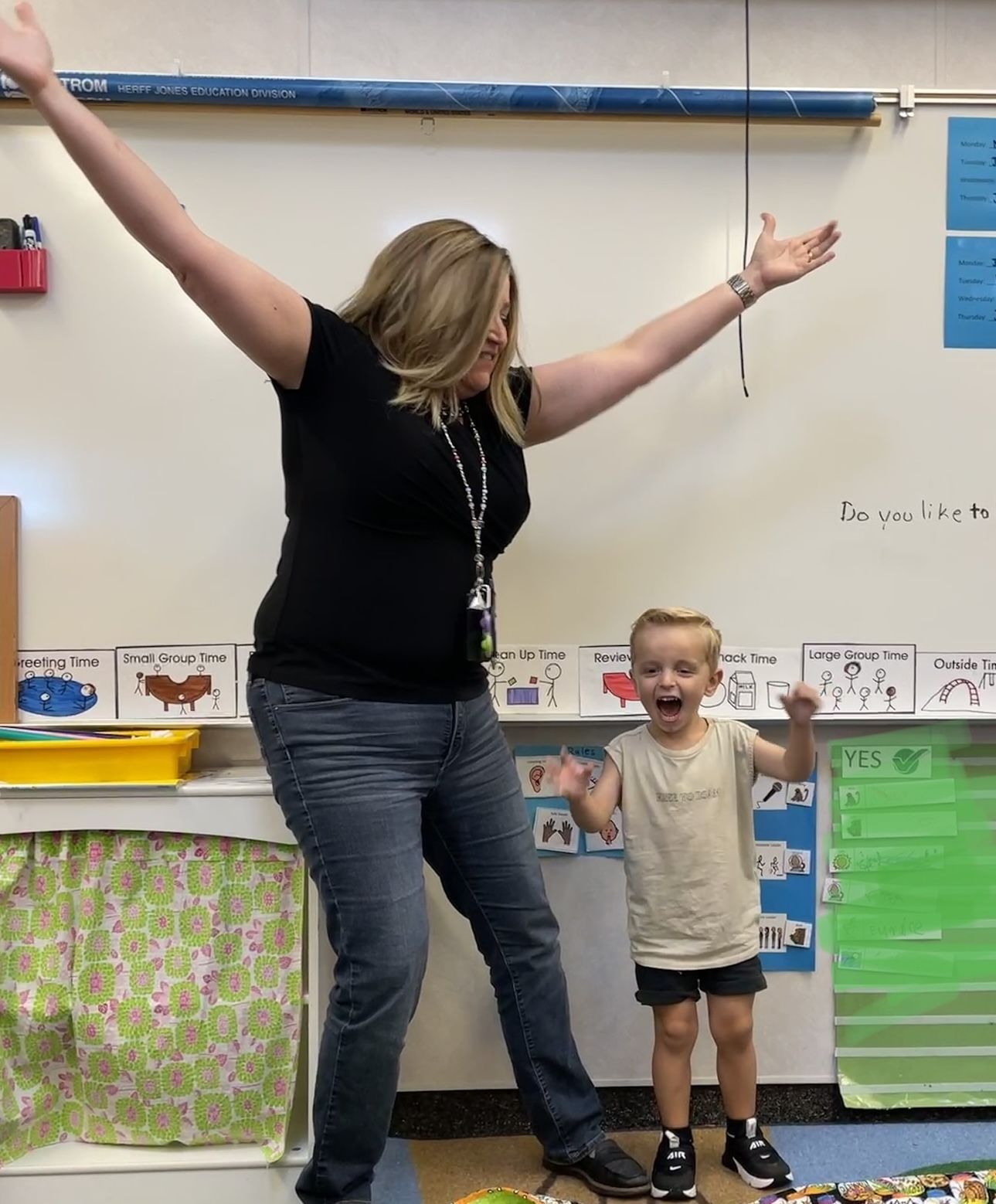
Miss Carrie's Crown


Miss Carrie wears a crown all week long for her birthday week.  Mainly, because it does promote a lot of language as children attempt to tell her what is on her head.  But also, because she likes wearing it and does it just one week a year.


Thursday, September 22, 2022

Pop! Pop! Pop! It's POPCORN!

 Transition Song: Bouncy Bouncy Bouncy

Vocabulary and Basic Concepts:  quiet/loud, slow/fast, popcorn, pop/popping/pops/popped, farm, garden, grow, heat, hot/cold, cook, stove, microwave, make, buy, I have/ I don't have, I like/I don't like, What/Where/Who, snack, pour/pouring/poured, oil, sprinkle, jump/jumping/jumps/jumped, clap/clapping/claps/clapped, lid, turn up, crunchy, salty, good.

This week, Miss Carrie told us that her favorite snack is popcorn.  She loves to make popcorn at home or have popcorn at the movie theater.  Some people make popcorn in the microwave and some make it on top of the stove.  Popcorn seeds are hard.  They have to have heat to pop into popcorn.  We read a book that showed people eating popcorn, what corn looks like when it is growing, and how to make it.


Then Miss Carrie taught us the popcorn song.  We started by singing quietly, then we sang louder. Miss Carrie sang first and we sang it after her.

Pour on the oil
(pour on the oil)
Sprinkle in the popcorn
(sprinkle in the popcorn)
Put on the lid
(put on the lid)
Turn up the heat
(turn up the heat)
sizzle, sizzle, sizzle, sizzle
Sizzle, Sizzle, Sizzle, Sizzle
SIZZLE, SIZZLE, SIZZLE,
POP!
Hear the popcorn, watch it pop
POP! POP! POP! POP!
Now we stop!
Let the teachers show you how it is done. 

DO THIS AT HOME:  Let your child lead as much as possible to teach your family the Popcorn song at home.  Make popcorn for a snack.  Talk about what it tastes like and see who likes it.


Friday, September 16, 2022

Science Experiment: Will It Bounce?

Song: Bouncy Bouncy Bouncy

Vocabulary and Basic Concepts: experiment, bounce/-ing/-ed, yes/no, do/do not, high/low, 1-2-3, drop,  roll/-ing/-ed, fast/slow, me/my/mine, He/She, His/Hers, Who/What/Where, my turn, predict.

Miss Carrie said we were going to try an experiment.  An experiment is when we try something to see what happens. Last week, we experimented with bouncing balls. But, do other things bounce? 

Hmmmm......

First, we tried stretch strings.  We held them up high, counted together "1-2-3-DROP!" Everyone dropped it at the sane time.  What happened?  Did it bounce? No, they didn't bounce.  They just stayed there on the floor.  We tried it again to be sure. "1-2-3-DROP!"  Hmmm.  Stretchy strings do not bounce.

We tried dinosaurs.  "1-2-3-DROP!" What happened? Did they bounce?  No, they kind of rolled.  Dinosaurs do not bounce. We tried it twice to be sure.

We tried bean bag animals.  "1-2-3-DROP!"  What happened?  Did they bounce?  One child responded that her frog flopped.  We tried twice.  No, bean bag animals do not bounce.

We experimented with blocks.  Some of the kids noted that blocks are square.  Maybe these will bounce?  "1-2-3-DROP!" What happened?  Some said their block bounced a little bit.  Others said their blocks rolled.  We determined that blocks do not bounce.  At least, they don't bounce like balls.

What if we experiment with something round?  These cotton snowballs are round.  They look like balls.  Will these bounce?  "1-2-3-DROP!" They bounced! Not nearly as much as a bouncy ball.  One child said that these were too hard to catch.  So our pretend snow balls do bounce.  At least a little bit.

Last, Miss Carrie reviewed what items we experimented with.  Stretchy strings, dinosaurs, bean bags, blocks, and balls.  There was one more thing we didn't try.


DO KIDS BOUNCE?

As soon as Miss Carrie asked this questions, no one needed more instruction.  Every child started bouncing.  
YES, KIDS DO BOUNCE!

Do this at home:  try your own science experiments.  
During bath time, you could determine DOES IT FLOAT?
During a walk, why not experiment with DOES IT HAVE EYES? (Be on the look out!)
Playing on the floor with your child, pull out some toys to shake or rattle.  DOES IT MAKE NOISE?
During a family meal: DOES IT CRUNCH? (yes, this requires everyone to chew with their mouth open. We try this experiment during Snack Time as well.)


Friday, September 9, 2022

Who Is Behind The Blanket

 Transition Song: Bouncy, Bouncy, Bouncy

Vocabulary and Basic Concepts: blanket, Who, behind/in front, counting to 5, My turn, Your turn, yes/no, He/She, peer names, greeting peers.

This week, Miss Carrie brought her special blanket.  She taught us how to play Who Is Behind The Blanket. (Note: I know this sounds simplistic, but the kids REALLY love it!).

First she taught us this song:

Who is behind the blanket?

Who is behind the blanket?

Who is behind the blanket?

1-2-3-4-5!

(I recorded this video a few years ago)

Then Miss Carrie showed us how to play the game.  She hid behind the blanket.  We sang the song together.  When we counted to 5, Miss Carrie dropped the blanket and asked "Who is it?"  We had to remember peer names. Then, Miss Carrie said "Say hi to Miss Carrie."  Everyone waved and called out "Hi, Miss Carrie!" (Note: Greeting peers is a huge game changer in making friends.  It is a great skill to learn.)

Everyone got a turn to go behind the blanket.  We could say "My turn!" or remind peers "Your turn!"


DO THIS AT HOME:  This is a simple and fun game to do with the whole family.  Put your child in the lead and have them teach the song (with support from you as needed). Let them hold the blanket if they'd like. Practice family names and greeting by name.  Get extended family members involved over video if possible.


Thursday, September 1, 2022

Bouncing Balls

 Transition Song: Bouncy, Bouncy, Bouncy

Vocabulary and basic concepts: box, guess, ball/s, high/low, big/small, red, yellow, green, blue, purple, orange, bounce/bounces/bouncing/bounced, sitting, standing, turn-taking, My turn, roll/rolls/rolling/rolled, count/counts/counting/counted.

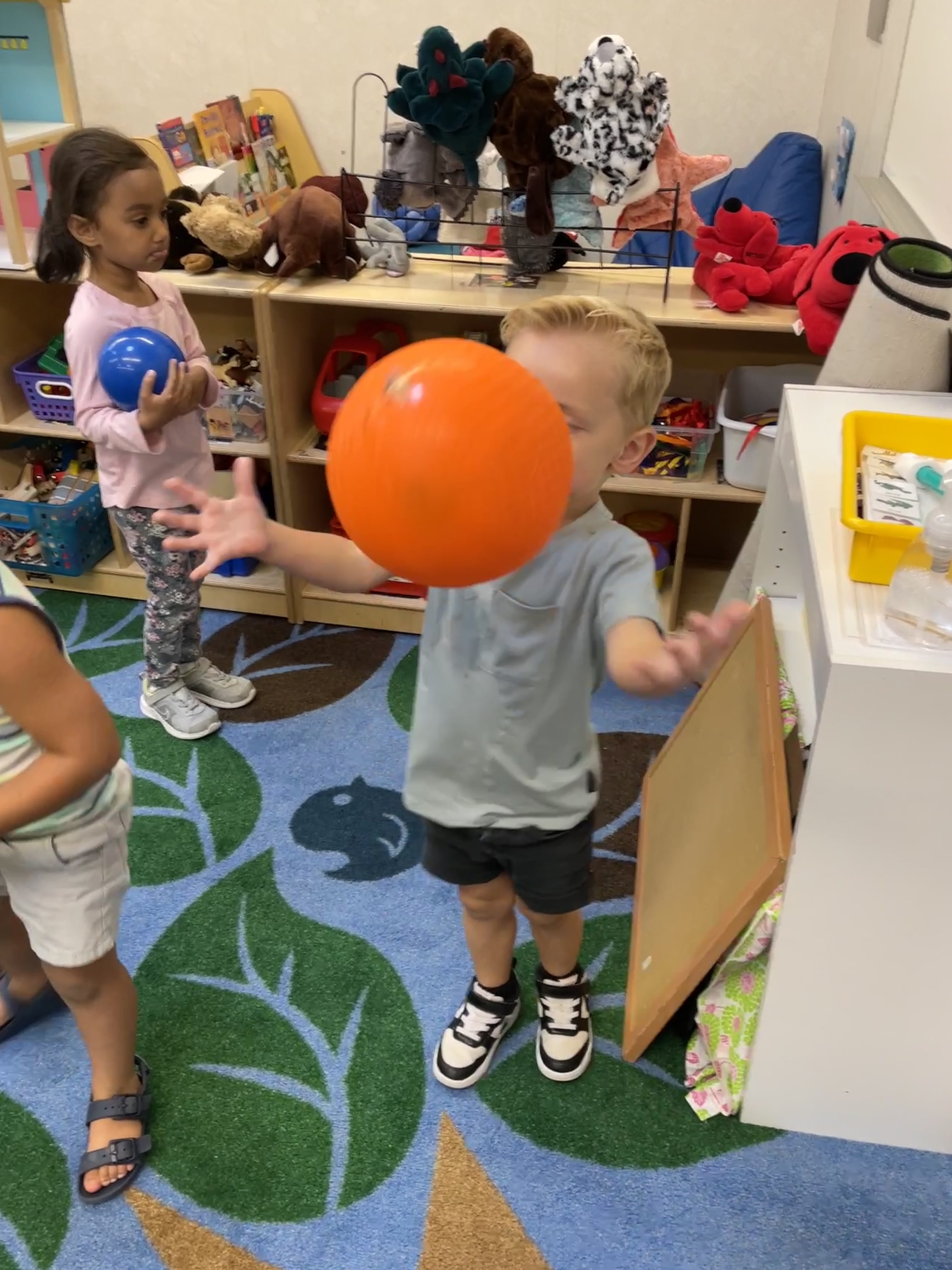
This week, Miss Carrie brought a box.  What is in the box?  It's something that bounces.  Everyone guessed what it could be.  There were balls in the box. How many balls did Carrie have.  She had six balls.  We counted how many kids we have in the class.  Sometimes we had enough balls, and sometimes we had to find more balls.  What can we do with the balls?  We practiced bouncing and catching (this is a skill we mark in the DOT data). We rolled the ball, bounced the ball, and caught the ball.  We talked about what color ball we had.  If we wanted to trade, we could ask a friend.


DO THIS AT HOME:  have a family ball game and talk about high/low, fast/slow, big/small.  Narrate everyone's actions in an 'announcer voice'.

Fun library books about balls:

Froggy Plays Soccer by Jonathon London

Watch Me Throw The Ball by Mo Willems

Rosa Plays Ball by Jessical Spanyol


Thursday, August 25, 2022

Washing Hands

Transition Song: Bouncy Bouncy Bouncy by Rachel Arnston on her Volcalomotion album.  I filmed it at my house during the pandemic when schools were shut down.


Vocabulary and Basic Concepts: wet/dry, germs, wash/washing/washed, hands, mouth, cough, nose, sneeze, shoulder, elbow, experiment, toys, yes/no, soap/water, clean/dirty, help, messy, paint.

This week, Miss Carrie talked about germs.  Germs are little bugs that live on our hands. They are so tiny that we can't see them.  But they can make us sick. If we put our hands in our mouths and then touch toys, that can make people sick.  If we sneeze or cough into our hands, that can make people sick, too.

If kids get sick, they can't come to school!  If teachers get sick, they can't teach.  We want to keep everyone healthy at school.

We learned how to cough or sneeze into our elbows.  Grab your shoulder, put your elbow up, and cough or sneeze into your elbow.

We learned how to wipe our noses.  There are tissue boxes all around the room.  We use a tissue to pinch our nose gently and wipe. Then we throw the tissue into the trash and wash our hands.  If teachers see our fingers in our noses or our mouths, the teachers will ask us to wash our hands.

Miss Carrie did an experiment.  She painted with her hands.  Paint was all over her hands.  Can she touch toys with paint all over her hands? No!  They are messy.  Everyone told Miss Carrie to wash her hands.

Look what happened to Miss Carrie's hand!  She needs to wash it.

Miss Carrie asked if anyone wanted to give her a high-five.  Some kids did.  They had to go wash their hands when paint got on them.  Other kids said No, they did not want to give her a high-five.  They still practiced washing their hands with soap at the sink.


We have a song we use at preschool to wash our hands.  Everyone practiced the song with Miss Carrie.

(I filmed this song when we still had to wear masks at school. This is the song we sing when we wash our hands to make sure the soap stays on our hands long enough to wash off the germs.)

DO THIS AT HOME:  Talk about washing hands and practice at home with the whole family.  Practice wiping noses together. Let your child be as independent as possible while doing this. Washing their hands and wiping their noses is a great skill to learn.

Thank you for keeping sick kids at home!  We really appreciate it when parents are actively helping teachers to stay healthy.

Great books to find at the library about getting sick:

Llama Llama Home With Mama by Anna Dewdney

Get Well Soon, Spot by Eric Hill

Bear Feels Sick by Karma Wilson

How Do Dinosaurs Get Well Soon by Jane Yolen


Friday, May 13, 2022

I Can Rhyme

 Transition Song: The Circle Time Song by The Kiboomers


Vocabulary and Basic Concepts: rhyming, same/different, Wh-questions

Materials:  Silly Sally by Audrey Wood, rhyming books (particularly board books), Scholastic Rhyming 3-Piece Puzzles.

This week, Miss Carrie talked about rhyming words.  Rhyming words sound the same at the end, just the first sounds are different.  We talked about cat/hat, band/hand, house/mouse, and see/bee.  

Miss Carrie read Silly Sally.  There are parts of the book that say the same thing every time.  We helped Miss Carrie read those parts.  We listened for rhyming words.

Then Miss Carrie brought out enough books for everyone.  There were rhyming puzzles, too.  We could choose if we wanted to read a book or try puzzles.  Some of the puzzles had pictures we didn't know.  Teachers could help us with those words.


DO THIS AT HOME: grab your favorite rhyming book and read it together.  Pause as you read the second rhyming word of a pair, then ask "What rhymes with (1st rhyming word).  Then help as needed.  Find rhyming words in every day activities to point out.  Blue shoe.  Make cake.  See bee.  Cat hat.