Thursday, February 20, 2020

Video Game Violence And Children

Every so often I post articles I find interesting. This article from The American Academy Of Child & Adolescent Psychology is titled Video Games And Children : Playing With Violence. Click on the title to link to the article.  I wanted to put two takeaways here from the article:

"Studies of children exposed to violent media have shown that they may become numb to violence, imitate the violence, and show more aggressive behavior. Younger children and those with emotional, behavioral or learning problems may be more influenced by violent images."

and...

Tips for Parents
Parents can help their children enjoy these video games appropriately and avoid problems by:
  • Avoiding video games in preschool-aged children (emphasis added)
  • Checking the ESRB ratings to select appropriate games—both in content and level of development
  • Playing video games with their children to share the experience and discuss the game’s content
  • Setting clear rules about game content and playing time, both in and outside the home
  • Monitoring online interactions and warning children about potential dangers of Internet contacts while playing games online
  • Allowing video game playing only in public areas of the home, not in the child’s bedroom
  • Remembering that you are a role model for your children including which video games you play and how long you play them
  • Enforcing total screen time limits
  • Ensuring video games are only played after homework and chores are done
  • Encouraging participation in other activities, particularly physical activities


February Week 3: H-H-H

Transition Song: H-E-A-R-T by the Kiboomers

Vocabulary and Basic Concepts: Who/What/Where questions, big/little, labeling, describing words, have, yes/no, Heart, house, hippo, horse, hand, horseshoe crab, helicopter, honey, hamburger, hotdog, harmonica, hair, hammer, hat, hammock, hanger, helmet, Humpty Dumpty.

This week Miss Carrie taped pictures all around the room.  All the pictures started with the /h/ sound.  We practiced on our hands so we could feel the air moving out of our mouths.  /h-h-h/. We were going on a hunt for /h/ pictures!

Everyone pretended to hold binoculars to their face and said this: "Binoculars up! I have a picture and it starts with /h/."  Then we found the pictures around the room.  What is it?  Where have I seen it before?  Who has one at their house?  Do you like it or don't like it?  Is it big or little?  If there was time, Miss Carrie gave us pictures to match with the pictures we were hunting.

We knew most of the words but we didn't know horseshoe crab or harmonica. Miss Carrie showed us a video of horseshoe crabs.  She really likes horseshoe crabs.

Then Miss Carrie showed us a video of a 6 year old kid playing the harmonica.  We noticed that he was blowing so his cheeks puffed out.  We noticed that sometimes he moved his hand to make the sound different.


DO THIS AT HOME:  Go on a hunt for pictures and objects around your house, around the park, around the store, or where ever your are. Pick a sound. What can you find?  Talk about the picture/object.  Ask What/Where/Who questions, describe it (big, yellow, small, bumpy, soft), Do you like it/don't like it. Make sure you repeat the sound over and over during play to reinforce it. Picking the first sound in your family names is a good place to start.


Thursday, February 13, 2020

February Week 2: What Do You Hear?

Transition Song: H-E-A-R-T by the Kiboomers

Vocabulary and Basic Concepts: hear, loud/quiet, listening ears, quiet mouths, big/little, lion, tiger, bear, elephant, cow, pig, horse, dog, cat, duck, frog, chicken/rooster, bird, monkey, zebra, snake,  peacock, eagle, penguin, owl, turtle, bee, bat, hippo, camel, flamingo, What/Where questions, “I hear” phrases, home/farm/zoo.

This week we played the game "What Do You Hear".  Miss Carrie reminded us to use our listening ears and quiet mouths so we could hear.  She has an app (Soundtouch 1 & 2) that plays animal sounds.  We listened to the animals and guessed what they were.  Then we looked at the photographs of animals to see if we were right.  We talked about if we had seen an animal like that at home, on farms, or at zoos. 


Miss Carrie played a lot of different sounds.  We knew sounds like dog, cat, cow, and elephant. We were stumped with zebras, peacocks, hippos, and alligators.  We discovered that if we didn't have quiet mouths while we were listening, we couldn't hear the animal sounds.  It was so much fun to guess!  It was so much fun to try to sounds like the animal.

DO THIS AT HOME:  play animal sounds and take turns guessing.  You could find them on the computer or you could make the sounds yourself.  Or go to the zoo or to a farm, listen for sounds, try to identify the sounds.

Friday, February 7, 2020

February Week 1: Hiding Phil

Transition Song: H-E-A-R-T by te Kiboomers

NOTE: We sing just the first verse, clap on each letter H-E-A-R-T while we singing an repeat it a second and sometimes a third time.

Vocabulary and Basic Concepts: over/under, hide/hiding, descriptive words, locations vocabulary pertaining to the classrooms, first/next/last, Where questions, Who questions, He/She/We/They

This week we read the book Hiding Phil by Eric Barclay.  

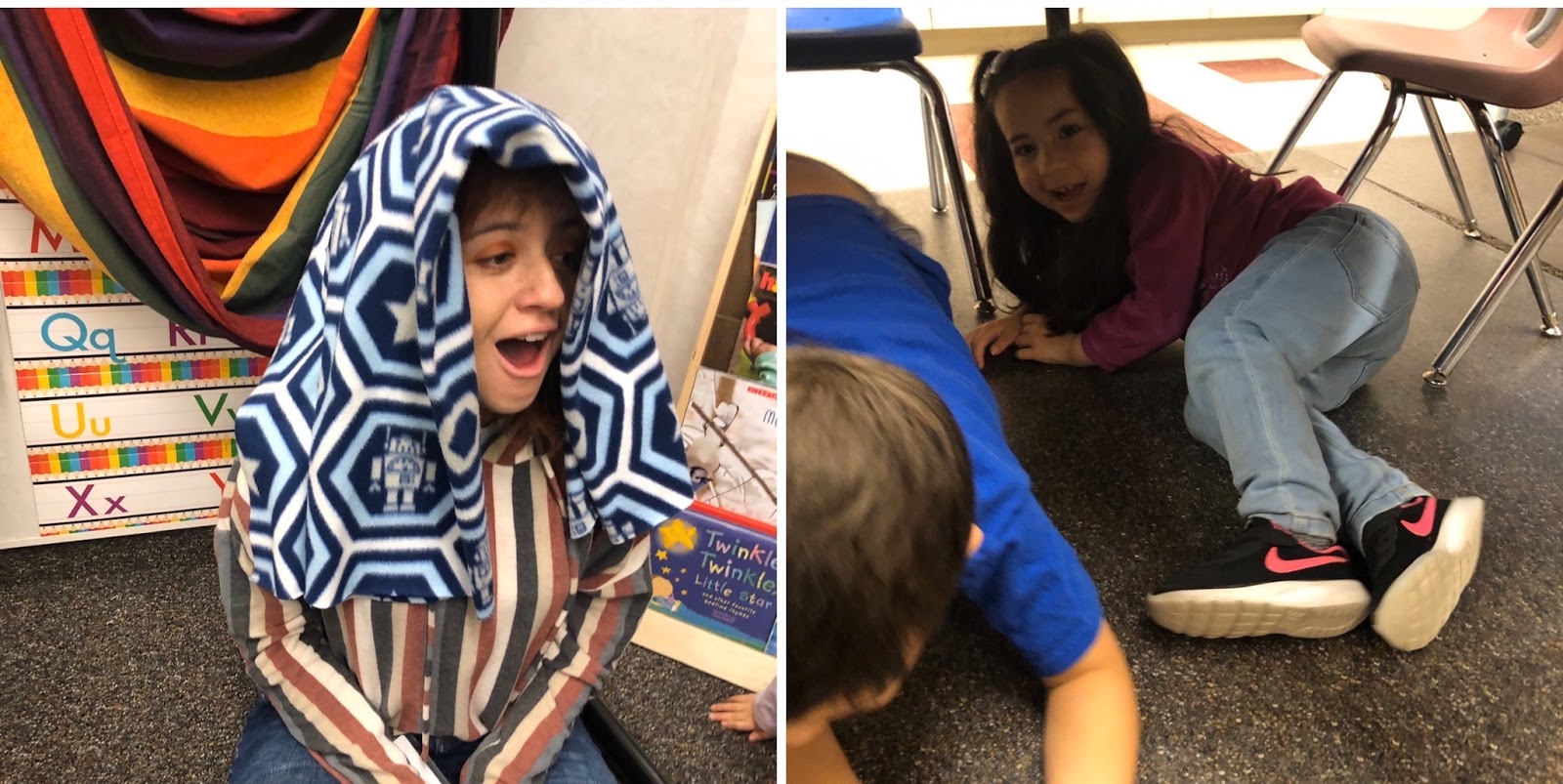
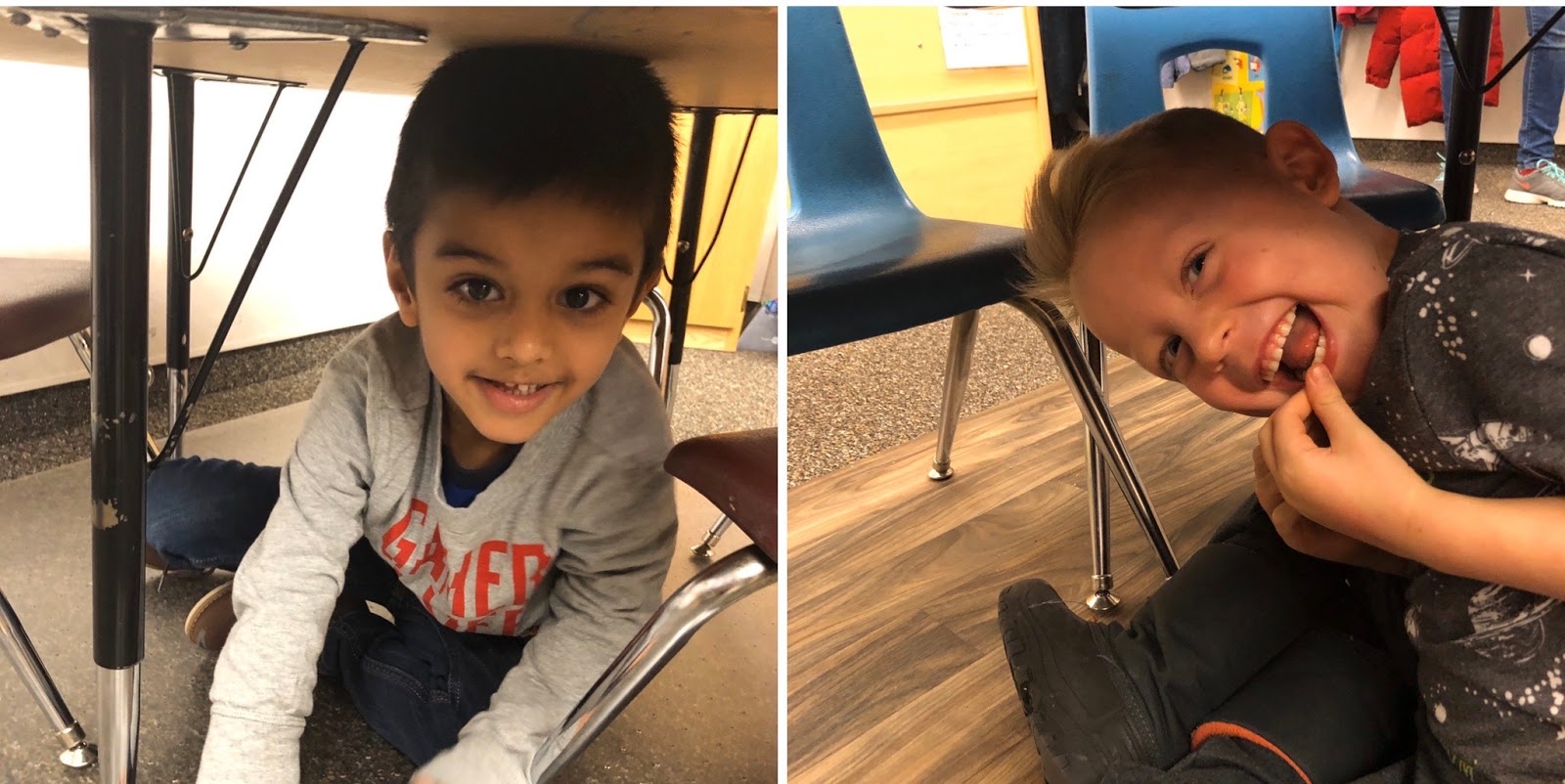
Phil is an elephant.  The kids want him to stay but they need to hide him under things.  It didn't work!  It was so much fun to see where Phil hid.  It was fun to find the dog in each picture.  Wait till you see where Phil hid last! We decided to play hide-and-seek and hid under tables, chairs, coats, blankets, and stuffed animals. Miss Carrie counted to 10 and then came to find us.  When she found us, she took our picture!  Then we looked at the pictures and talked about Who was in the picture and Where they were hiding.


DO THIS AT HOME:  play hide and seek and take pictures.  Talk about who is hiding where.  Talk about hiding under objects.  Laugh at the pictures and show them to your family.  Get everyone involved.

Friday, January 31, 2020

January Week 4: Drum Those Drums

Transition Song: Colors by The Learning Station

Vocabulary and Basic Concepts: loud/quiet, fast/slow, stop/go, big/little or small, in/out, open/closed, under/over, big/bigger/biggest, small/smaller, smallest, beat, drum, box.

This week Miss Carrie brought out boxes. So. Many. Boxes.  There were big boxes and little boxes.  we were going to drum!  But first we had to know how to stop and listen. We practiced putting our hands up whenever Miss Carrie said "Hands UP!" This meant "stop drumming and listen to directions".

Ready, set, GO! We drummed LOUD!  We discovered that when we were drumming loud, we couldn't hear Miss Jeana or Miss Jen talking.  When we drummed quietly, then we could hear them. We experimented with drumming fast and slow. We practiced go and stop (which was "hands up").

What else could we do with boxes.  We tried getting in them.  Some boxes were too little.  We could hide under them by putting them over our heads.  Some boxes were so big that we could get into them and close them. Our friends would open the boxes to find us.  We had so much fun exploring all of the boxes.


DO THIS AT HOME:  Find some boxes and make some noise.  Explore what else you can do with the boxes.  Make a fort.  Play hide and seek.  Make houses and color features on the boxes.  Let our child take the lead on what to do.

Friday, January 24, 2020

January Week 3: Do What I'm Doing

Transition Song: Colors by The Learning Station

Vocabulary and Basic Concepts: colors, body parts, look, watch, move, swing, sway, stomp reach, throw, blow, up/down, forward/backward, high/low, fast/slow, big/little, present progressive -ing, past tense-ed, Pronouns I/He/She/We + is/am/are, What questions, Who questions.

This week Miss Carrie brought her scarves.  There were lots of different colors.  If we didn't get the color we wanted, we could ask our friends to trade.  Then we danced and moved with our scarves.  Our teachers had to watch us and copy what we did.  We ha so much fun showing what we could do.  Scarves waved high and low.  We threw scarves in the air and caught them.  Then we threw them at our friends.We jumped, stepped, swayed, and swung our arms.  We sat on the floor to see what other ways we could move with just our upper bodies. Miss Carrie played fast music and slow music.


DO THIS AT HOME:  Pull out scarves or not.  But do put on some music an dance!  Follow your child's lead.  "What are you doing?  Oh, look, I see that you are stomping your feet.  I wonder if I can do that?  Stomp!Stomp!Stomp!"  "You are shaking your arms fast!  I can shake them fast, too!" Use your best sports broadcaster voice and give a play-by-play.  Have your child tell you what they are doing and let them correct you if you do it wrong.  Or, use single word narration to talk about what your child is doing to hep them label: "Stomp! Swing! Arms! Legs! Head! Shake! Fast!"

Friday, January 17, 2020

January Week 2: Dinosaur, Dinosaur

Transition Song: The Color Song by The Learning Station

Vocabulary and Basic Concepts: same/different, big/little, loud/quiet, long/short, smooth/spiny, stomp, walk, fly, run, swim, eat, identify parts of a whole (EX: The head of the dinosaur), head, back, feet, Who questions, What questions, Where questions.

This week we read a book together called Dinosaur, Dinosaur by Byron Barton.


Every time Miss Carrie said the word dinosaur we clapped it and said it with her.  The word is divided up into three parts called syllables. We practiced the word over and over.  We said dinosaur with fierce voices, with hungry voices, with tired voices, with tiny voices,  and with big voices.

Then Miss Carrie brought out toy dinosaurs. They looked just like the ones in the book!  We traded with friends if we wanted to.  Then Miss Carrie told us to look at the head of the dinosaur.  We found the head.  Miss Carrie showed us pictures and asked if our dinosaur looked like the picture.  We looked at the back of the dinosaur and the tail of the dinosaurs.  Everyone had dinosaurs that looked different. We talked about which dinosaurs walked on two feet and which ones walked on four feet.


DO THIS AT HOME:  pick out some favorite toys and compare and contrast.  What looks the same and what looks different?  Point out the parts of the toy.  Be sure to get down on the floor and play with the toys with your child.  Let your child lead on what to do.